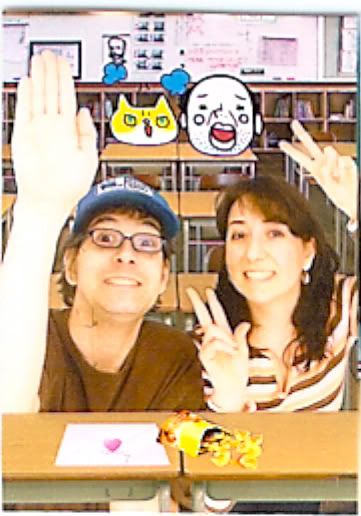
In the second part of our semester, we'll be exploring story-telling using stop-motion animation, or pixilation. Below are some interesting examples that student 김혜림 found for us:
Another one! CLICK HERE! And here! And here! And here!
Thanks to Hye Rim for finding these for us!
Please post links to other cool pixilation videos you find, below.
Tuesday, November 10, 2009

Tuesday, October 13, 2009
Studio Time
As you continue working with your groups to make your midterm projects, I thought I would post some snapshots of our class process to inspire you!
"Fighting!" ^^

This is Mr. Park Min-chul at the KOFIC lab, who helped us do the digital transfer of our original tests.


Students working hard!
"Fighting!" ^^

This is Mr. Park Min-chul at the KOFIC lab, who helped us do the digital transfer of our original tests.


Students working hard!
Wednesday, September 23, 2009
Sunday, September 20, 2009
Week 3: Chemical Craft
Hand-Processing
Several artists also experiment with film chemistry by processing their own films by hand. In Steve Sanguedolce's films, you can see examples of hand-processed black and white film. He also tints and tones his films using special dyes first used in the early days of filmmaking.

(Image: stevesanguedolce.com)
CLICK HERE to see a clip of Steve Sanguedolce's work on his website.
Deirdre Logue is a Canadian artist who created many films with hand-processing, tinting, and toning techniques. In her short film, "Moohead," she also experiments with found footage. Using found footage also may be called collage, too.

(Image: deirdrelogue.com)
CLICK HERE to see a sample of "Moohead," by Deirdre Logue.
Amanda Dawn Christie has made many films by exploring different kinds of film laboratory techniques. In her 2006 film, "3Part Harmony: Composition in RGB #1," she filmed herself dancing using black and white film. Then, she used an optical printer to re-photograph each frame onto filmstocks that would only show the image in magenta, yellow, or cyan. Finally, she re-photographed each frame again, putting all three colors onto the final film. The film shows her performance as a dancer, and also her performance as a filmmaker.

(Image: lightcone.org)
CLICK HERE to watch "3part Harmony: Composition in RGB" online.
As you can see, hand-made filmmaking is very different from digital filmmaking in both process and product. Hand-made cinema borrows its processes from painting, print-making, chemistry, and drawing, as well as traditional photography. How these processes are used is a decision each artist must make for him or herself. Spending time thinking about process is a very important part of any artist's work.
Several artists also experiment with film chemistry by processing their own films by hand. In Steve Sanguedolce's films, you can see examples of hand-processed black and white film. He also tints and tones his films using special dyes first used in the early days of filmmaking.

(Image: stevesanguedolce.com)
CLICK HERE to see a clip of Steve Sanguedolce's work on his website.
Deirdre Logue is a Canadian artist who created many films with hand-processing, tinting, and toning techniques. In her short film, "Moohead," she also experiments with found footage. Using found footage also may be called collage, too.

(Image: deirdrelogue.com)
CLICK HERE to see a sample of "Moohead," by Deirdre Logue.
Amanda Dawn Christie has made many films by exploring different kinds of film laboratory techniques. In her 2006 film, "3Part Harmony: Composition in RGB #1," she filmed herself dancing using black and white film. Then, she used an optical printer to re-photograph each frame onto filmstocks that would only show the image in magenta, yellow, or cyan. Finally, she re-photographed each frame again, putting all three colors onto the final film. The film shows her performance as a dancer, and also her performance as a filmmaker.

(Image: lightcone.org)
CLICK HERE to watch "3part Harmony: Composition in RGB" online.
As you can see, hand-made filmmaking is very different from digital filmmaking in both process and product. Hand-made cinema borrows its processes from painting, print-making, chemistry, and drawing, as well as traditional photography. How these processes are used is a decision each artist must make for him or herself. Spending time thinking about process is a very important part of any artist's work.
Monday, September 14, 2009
Week 2: Scratching the Surface
This week, we will learn more about how you can have more 'hands-on' control of motion picture film. Today, we'll explore different processes of hand-made film and we'll get to know the material of film better. For many artists, the process, or how a film is made, is as important as the product (the final film).In many of the films included in today's discussion, experimenting with process is a big part of why the artist chose to make the film. How is process important to you, as an artist?
The Film Material
Last week, you experimented with painting on clear plastic film. This clear, plastic film is called film leader. It is called leader because it is typically attached to the beginning of the film, so the film can be threaded through the projector. This week, we will use film that has emulsion (light-sensitive chemicals that make a photographic image) on its surface. We will also see many different ways artists use film emulsion to create new images.
The earliest films were only black and white. The only way to put color into film at that time was to add special dyes to tint and tone images one or two colors, as a special effect. Later, chemicals sensitive to specific light spectra were added to films, and this made natural-looking color possible on film. There are many kinds of color film emulsions and many kinds of film stocks, but generally, the layers of film look like this:

(Image: howstuffworks.com)
Scratching the Emulsion
If you scratch or bleach the emulsion, it comes off its plastic base. This is one way artists can create new images on film. Caroline Leaf is one artist who used this technique to create her short animated film, "Two Sisters."


You can CLICK HERE to watch her film.
Collage
Collage is another method of creating hand-made film. Stan Brakhage, an American experimental film artist, collaged small items found in nature - such as moth's wings, pieces of grass, seeds, etc., to make his film "Mothlight". This film is considered very important to experimental filmmakers.

(Image: cca-glasgow.com)
CLICK HERE to watch "Mothlight" by Stan Brakhage.
In my film, "Assembled," I scratched on film emulsion and collaged together other pieces of film to make images of people watching movies. I collaged small pieces of other film onto the main film using tape and glue.

(Image: Becka Barker)
CLICK HERE to watch Becka's film, "Assembled."
Think of all the techniques we've learned about so far:
painting
drawing
scratching
bleaching
masking and bleaching
collage
...how can you combine these different styles to make a film that shows your unique ideas?
You will have one more class (Sept 23) to create short tests (3-4 seconds long) to try out these techniques.
The Film Material
Last week, you experimented with painting on clear plastic film. This clear, plastic film is called film leader. It is called leader because it is typically attached to the beginning of the film, so the film can be threaded through the projector. This week, we will use film that has emulsion (light-sensitive chemicals that make a photographic image) on its surface. We will also see many different ways artists use film emulsion to create new images.
The earliest films were only black and white. The only way to put color into film at that time was to add special dyes to tint and tone images one or two colors, as a special effect. Later, chemicals sensitive to specific light spectra were added to films, and this made natural-looking color possible on film. There are many kinds of color film emulsions and many kinds of film stocks, but generally, the layers of film look like this:

(Image: howstuffworks.com)
Scratching the Emulsion
If you scratch or bleach the emulsion, it comes off its plastic base. This is one way artists can create new images on film. Caroline Leaf is one artist who used this technique to create her short animated film, "Two Sisters."


You can CLICK HERE to watch her film.
Collage
Collage is another method of creating hand-made film. Stan Brakhage, an American experimental film artist, collaged small items found in nature - such as moth's wings, pieces of grass, seeds, etc., to make his film "Mothlight". This film is considered very important to experimental filmmakers.

(Image: cca-glasgow.com)
CLICK HERE to watch "Mothlight" by Stan Brakhage.
In my film, "Assembled," I scratched on film emulsion and collaged together other pieces of film to make images of people watching movies. I collaged small pieces of other film onto the main film using tape and glue.

(Image: Becka Barker)
CLICK HERE to watch Becka's film, "Assembled."
Think of all the techniques we've learned about so far:
painting
drawing
scratching
bleaching
masking and bleaching
collage
...how can you combine these different styles to make a film that shows your unique ideas?
You will have one more class (Sept 23) to create short tests (3-4 seconds long) to try out these techniques.
Tuesday, September 8, 2009
Welcome to the Space Outside the Black Box
Hello students!
We will spend the next seven weeks exploring film in ways that might be new to you. Our theme is "Outside the Black Box." In English, sometimes the term "black box" has the same meaning as "cinema".
I want you to think of the idea of "outside." What do you think the meaning is, for this class?
Can film express something other than a story?
This blog will be like your textbook for the class. Pay special attention to bold words. Bold words are special vocabulary words we will discuss, in English, in class. You will be expected to know how to use these words in filmmaking.
.........................................................................................................
The Beginnings of Film
Almost 100 years ago, film was a new medium. Nobody had ever seen moving photographs before. Two brothers, Auguste and Louis Lumiere worked for their father in a factory that made chemicals and equipment for photography. In 1895, they made a machine called the "cinématographe". They tested their invention by shooting the factory workers as they left the factory at the end of the day. This was the first film ever made.
Film cameras shoot many tiny photographs onto a strip of celluloid. Small holes on the sides of the celluloid help register the film. That is, the holes help keep each photograph steady long enough for the brain to "see" the image. Seeing many photos each second tricks the brain into thinking it sees movement. This trick is called persistence of vision. Persistence of vision is an important concept in animation.
The Beginnings of Film as Art
Some artists were not interested in using film to tell stories. Marcel Duchamp was interested in understanding motion and human perception. It is easy to see this in his famous painting, "Nude Descending a Staircase":

He decided to try using film to make art about motion. In 1926, he created "Anemic Cinema," by filming spinning discs that sometimes appear 3-dimensional. The film also shows spinning words - French puns.
Man Ray was another modern artist of the early 20th century who experimented with different media. He used painting, photography, and film to explore Surrealist philosophy. He made photograms, which is a method of photography where objects are put on a piece of unexposed film. The film is exposed when a bright light shines on it for a short amount of time, and the object leaves a dark shadow on the film. You can see examples of Man Ray's photograms in the film, "Retour a la Raison" (1923). The photograms were created by small nails, string, and dirt being placed on the unexposed film.
Some artists decided to use film the same way that a painter paints on a canvas. In the early 20th century, painters like Piet Mondrian, Kazimir Malevich, and Wassily Kandinsky were exploring human perception with their abstract paintings. Two of the best known early artists to experiment with film in a similar way were Len Lye and Harry Smith. In Lye's film "A Colour Box" (1935) and Smith's "A Strange Dream" (1946), shapes are painted and scratched onto clear film leader. When the films are projected, they look like abstract paintings in motion.
Beginnings of Film Art in Canada
Norman McLaren lived and studied art in Scotland until the 1939, when he moved to New York. Like Len Lye and Harry Smith, McLaren was also interested in using film as a canvas, and he made several films without using a camera. In 1941, he was invited to move to Canada to start a national animation studio for the National Film Board of Canada (NFB). While he was there, he created some of his best-known films, such as "Begone Dull Care" (1949).
Norman McLaren also experimented with how to make sound in his films. In some of his films, he hand-painted his own optical soundtrack on the sides of the film. This documentary film shows McLaren in his studio, experimenting with different shapes to make sounds.
Here is one of his early films, "Dots" (1940), which features his hand-painted sounds.
Hand-Made Films Today
Many people thought photography would make artists stop painting when the first cameras were invented, but that didn't happen. Nowadays, many people think celluloid film will disappear, too. But several artists continue to use it as a material to express their own artistic ideas, because it is different from digital media.
Richard Reeves is a Canadian artist who creates all of his films completely by hand. He draws and paints every frame and paints his own soundtrack the same way Norman McLaren did. Here is a clip from his film "Linear Dreams" (1997).
This clip shows what Reeves' sounds LOOK like:
Several Korean artists also experiment with film. You can see many examples of Korean art films at the Seoul EXiS Festival this week. You can also visit Space Cell in Seoul to learn more about how to experiment with film, and meet artists who use film in this way.
How can you use film to communicate your ideas?
I look forward to seeing your creations!
We will spend the next seven weeks exploring film in ways that might be new to you. Our theme is "Outside the Black Box." In English, sometimes the term "black box" has the same meaning as "cinema".
I want you to think of the idea of "outside." What do you think the meaning is, for this class?
Can film express something other than a story?
This blog will be like your textbook for the class. Pay special attention to bold words. Bold words are special vocabulary words we will discuss, in English, in class. You will be expected to know how to use these words in filmmaking.
.........................................................................................................
The Beginnings of Film
Almost 100 years ago, film was a new medium. Nobody had ever seen moving photographs before. Two brothers, Auguste and Louis Lumiere worked for their father in a factory that made chemicals and equipment for photography. In 1895, they made a machine called the "cinématographe". They tested their invention by shooting the factory workers as they left the factory at the end of the day. This was the first film ever made.
Film cameras shoot many tiny photographs onto a strip of celluloid. Small holes on the sides of the celluloid help register the film. That is, the holes help keep each photograph steady long enough for the brain to "see" the image. Seeing many photos each second tricks the brain into thinking it sees movement. This trick is called persistence of vision. Persistence of vision is an important concept in animation.
The Beginnings of Film as Art
Some artists were not interested in using film to tell stories. Marcel Duchamp was interested in understanding motion and human perception. It is easy to see this in his famous painting, "Nude Descending a Staircase":

He decided to try using film to make art about motion. In 1926, he created "Anemic Cinema," by filming spinning discs that sometimes appear 3-dimensional. The film also shows spinning words - French puns.
Man Ray was another modern artist of the early 20th century who experimented with different media. He used painting, photography, and film to explore Surrealist philosophy. He made photograms, which is a method of photography where objects are put on a piece of unexposed film. The film is exposed when a bright light shines on it for a short amount of time, and the object leaves a dark shadow on the film. You can see examples of Man Ray's photograms in the film, "Retour a la Raison" (1923). The photograms were created by small nails, string, and dirt being placed on the unexposed film.
Some artists decided to use film the same way that a painter paints on a canvas. In the early 20th century, painters like Piet Mondrian, Kazimir Malevich, and Wassily Kandinsky were exploring human perception with their abstract paintings. Two of the best known early artists to experiment with film in a similar way were Len Lye and Harry Smith. In Lye's film "A Colour Box" (1935) and Smith's "A Strange Dream" (1946), shapes are painted and scratched onto clear film leader. When the films are projected, they look like abstract paintings in motion.
Beginnings of Film Art in Canada
Norman McLaren lived and studied art in Scotland until the 1939, when he moved to New York. Like Len Lye and Harry Smith, McLaren was also interested in using film as a canvas, and he made several films without using a camera. In 1941, he was invited to move to Canada to start a national animation studio for the National Film Board of Canada (NFB). While he was there, he created some of his best-known films, such as "Begone Dull Care" (1949).
Norman McLaren also experimented with how to make sound in his films. In some of his films, he hand-painted his own optical soundtrack on the sides of the film. This documentary film shows McLaren in his studio, experimenting with different shapes to make sounds.
Here is one of his early films, "Dots" (1940), which features his hand-painted sounds.
Hand-Made Films Today
Many people thought photography would make artists stop painting when the first cameras were invented, but that didn't happen. Nowadays, many people think celluloid film will disappear, too. But several artists continue to use it as a material to express their own artistic ideas, because it is different from digital media.
Richard Reeves is a Canadian artist who creates all of his films completely by hand. He draws and paints every frame and paints his own soundtrack the same way Norman McLaren did. Here is a clip from his film "Linear Dreams" (1997).
This clip shows what Reeves' sounds LOOK like:
Several Korean artists also experiment with film. You can see many examples of Korean art films at the Seoul EXiS Festival this week. You can also visit Space Cell in Seoul to learn more about how to experiment with film, and meet artists who use film in this way.
How can you use film to communicate your ideas?
I look forward to seeing your creations!
Subscribe to:
Comments (Atom)